Limits
How these pictures were made
Each picture here was made from a description and carries a label saying so. None shows a face, a maker's name, anything a visitor could read, or a real house.
AI-generated illustration. Not a real home or business.
Made from descriptions, not photographed
This installer is invented, so there is no crew to photograph, no roof it has worked on and no household that let it up the stairs. Every picture on the site was made from a written description by an image model, and each one says so where it appears.
Every picture on this site was generated. Most have nobody in them; two show an installer's gloved hands and forearms, never a face, and are labeled as generated people. No panel, inverter, meter or switch in any of them carries a maker's name or a label anybody could read.
- We do not show a real person in a picture: every picture here is generated and says so.
The seven rules the pictures keep
Each rule decided what a description asked for and what it kept out of the frame, and each picture was looked at before it was used.
No face in any picture
Most pictures have nobody in them. Two show an installer's gloved hands and forearms, never a face, and carry the label for a generated person.
No maker's name on anything
A real panel carries its maker's label on the back and a real inverter its name on the front, so the panels here are seen from the front, plain black, and no inverter, meter or switch is shown close enough to read.
Roofs the fire code would pass
No flat roof is covered edge to edge and no sloped roof up to its ridge: every array leaves its clear paths, as the fire code requires.
No ladder, van or truck
Each carries a maker's name or lettering. Nothing in any frame is a thing anybody could read, and there is no house number or street sign.
Nobody near a roof edge
No one is shown at a roof's edge, and no one is shown on a roof without a safety line.
Queens houses, as they are
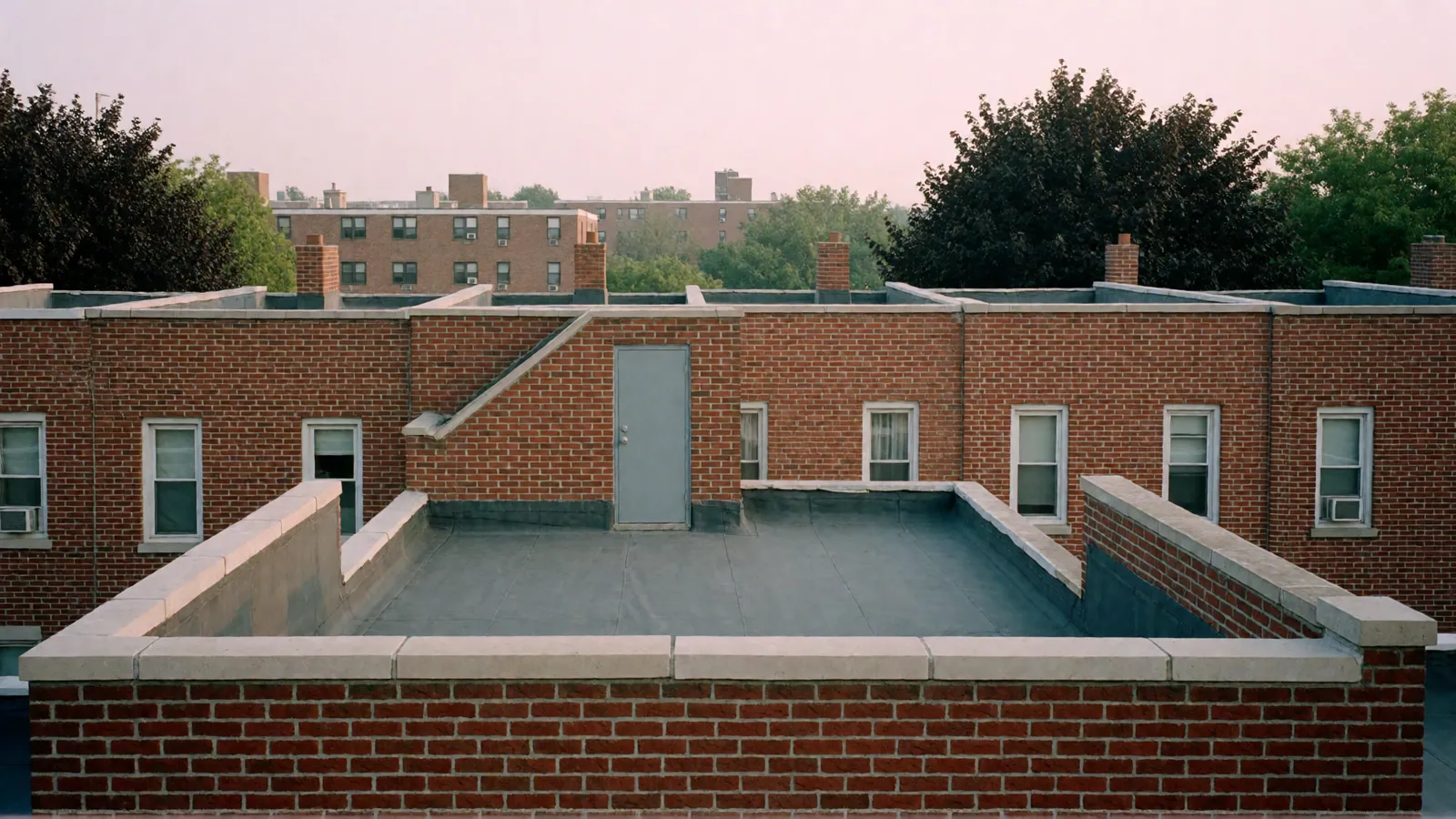
Flat roofs behind brick parapets with a bulkhead and a hatch, sloped shingle roofs on frame houses, street trees and taller buildings in the distance, but no skyline anybody could name.
Every picture labeled
Every picture carries the label "AI-generated illustration. Not a real home or business.", or with a person in it "AI-generated illustration. Not a real person, home or business.".
The two labels
AI-generated illustration. Not a real home or business.
On every picture of a roof, a house, a panel or a tool. A made-up row of brick houses can look exactly like the block you live on, and the label says the roof in it is nobody's, and no job this company did.
AI-generated illustration. Not a real person, home or business.
On the few pictures with an installer's gloved hands in them. The hands belong to nobody, and the label says so on the picture itself.
A page's header picture carries its label in a line under the heading. Every other picture carries it on the picture, and none appears without one.
Why there is a label at all
Each read against its source in October 2026.
- N.Y. General Business Law § 396-b (opens the source in a new tab) An advertisement that uses a generated person says so conspicuously.
- N.Y. General Business Law § 350 (opens the source in a new tab) False advertising in the conduct of any business is unlawful in New York.
The first rule is about made-up people, and the pictures with an installer's hands in them carry the label for one. Every other picture carries a label for the plainer reason behind the second: a made-up roof with panels on it is easy to take for a finished job, and somebody choosing an installer should never be shown work that was not done without being told so.
Why nothing in them can be read
The commonest picture on a solar site is a close look at a panel's corner, an inverter on a basement wall or a branded truck at the curb. Each of those is an advertisement for whoever made it: a panel carries its maker's label, an inverter its name, and a truck its lettering. This site names no maker, so its pictures cannot show one either, and the panels are seen from the front, where there is nothing to read.
Anything legible on an installer's site reads as a claim. Lettering on a van looks like a company with a license behind it, a sticker on a ladder looks like a brand, and a number on a front door looks like a real address. So there is no van, no truck, no ladder and no house number in any frame, and the people are never shown by their faces, because a face would be a person who does not exist.
The roofs keep their paths, because the fire code page says no roof here is planned without them, and a picture of a roof covered from parapet to parapet would contradict it. Nobody stands at a roof's edge, and nobody is up there without a safety line, for the same kind of reason: a picture is a promise about how the work is done.
A real installer built from this design would show its own crews and its own finished roofs, photographed as they are, and nothing a visitor could take for a badge, a brand or a promise it does not keep.
Size your roof
Try the roof sizing planner: panels, kilowatts and the roof they take at the published rate, in about three minutes. Sending it to us books nothing.