About
Questions homeowners ask before going solar in Queens
How a system is priced and sized, what the roof and the paperwork involve, what the incentives are as far as anyone can say, and what this company will not take on.
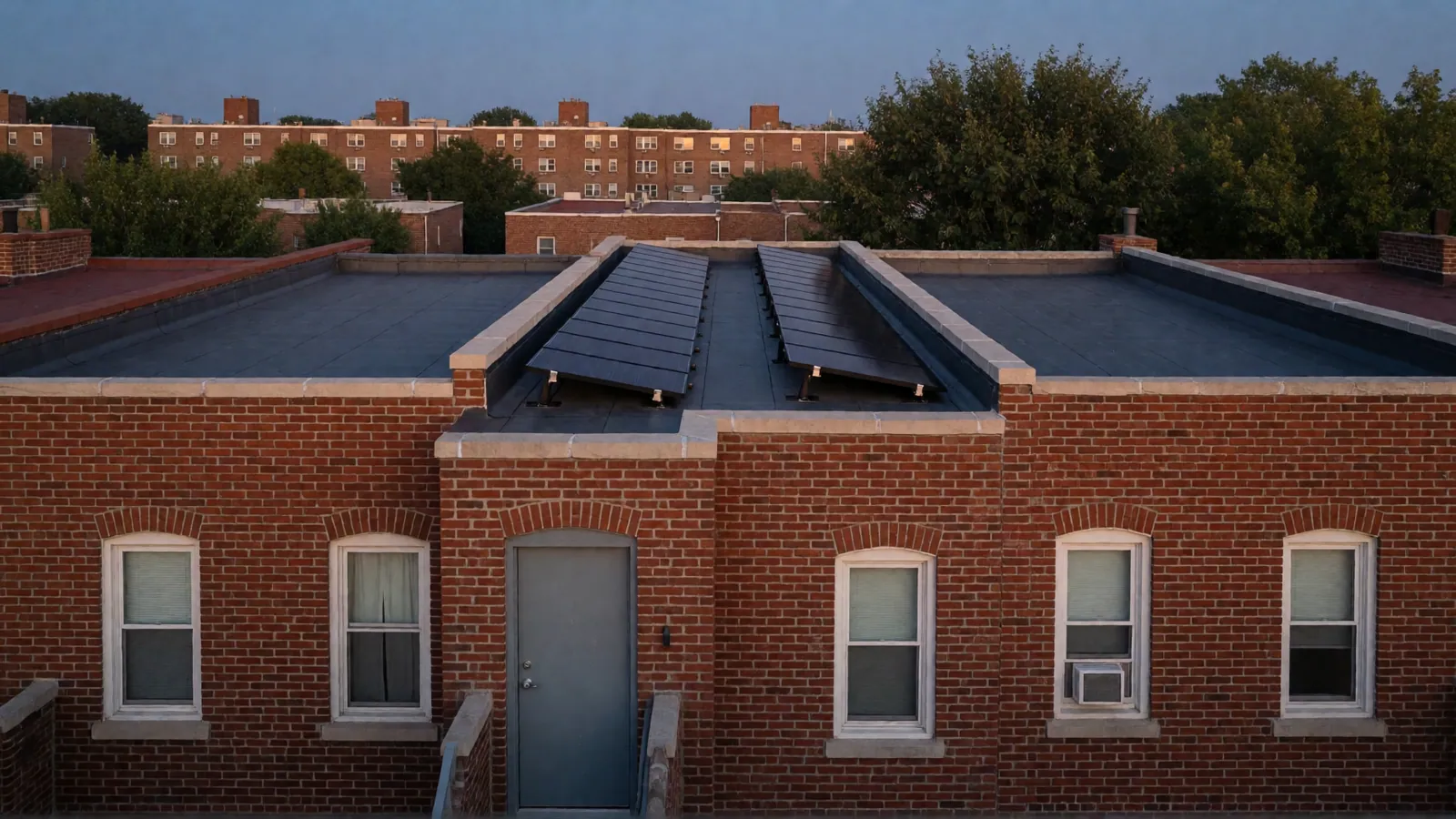
AI-generated illustration. Not a real home or business.
Thirty-five questions, and the site's own answers
Every answer here is word for word the sentence its own page prints, so the two can never drift apart.
How much does solar cost on a Queens row house?
The price is per watt of panels, by how they are mounted: $4.60 a watt on rails on a sloped roof, $5.20 a watt on low tilted frames on a flat roof, and $6.40 a watt under a raised canopy over a flat roof. It is the same for every customer on every day. A system's price is its watts times the rate, and each panel the company fits is 440 watts. The worked examples on this page show what that comes to for five real kinds of house.
What does a worked example look like for a row house?
For one of the worked examples on the rates page, a 1930s brick row house in Woodside with a flat roof about twenty feet wide, low tilted frames and a typical month of 500 to 700 kWh a month, the sizing range is 11 to 16 panels, 4.8 kW to 7.0 kW, and $25,168.00 to $36,608.00 before any incentive. There is no sales tax on a home solar system in New York City. Your answers will give your own range.
How many panels do I need?
The roof sizing planner turns your answers into a number of panels, the kilowatts they add up to and the roof they need, and works out the money from the published price per watt. Both ends of the range are printed the same size, because either can happen. It sizes a system the way an installer starts a design: from a year of your electricity use and a typical figure for what a panel makes on a Queens roof of that kind, then cut to what your roof can hold once the fire code's clear paths are kept. The smaller of the two sets each end of the range. What a real system would make is worked out in the contract, with the shading measured, and guaranteed there.
Is the planner's range an estimate?
A sizing range is not an estimate, a quote or a proposal, and nothing on this site is an offer. It is the number of panels your answers suggest, the roof they would take and their price at the published rate per watt, before any incentive. It says nothing about what a system would make or save. The system is designed after a survey of your roof and your electrical panel, priced in a written contract, and you can cancel that contract until midnight of the third business day after you sign it.
How much will I save?
No page on this site says what a system would save, what your bill would be, what a system would make or how soon it would pay for itself. Those depend on the utility's future prices, its yearly charges, your household's use and your own taxes, which nobody selling panels controls, and New York's rules require any savings figure an installer shows to sit beside a forecast built the State's way, from the past three years of your utility's real prices.
Is there still a federal tax credit?
As of October 2026, the federal residential clean energy credit no longer applies to a home solar system: it ended for systems whose installation was completed after December 31, 2025, even where some of the price was paid earlier. Incentives exist and change. Each has its own rules and limits, and what one is worth depends on your own taxes. This site does not work any of them out: check with the IRS, the State's Department of Taxation and Finance, the City's Department of Buildings, NYSERDA and your tax adviser before you rely on one.
What incentives are there in New York City?
As of October 2026, New York State offers an income-tax credit for solar equipment at your main home, with its own limits; a bill to change it has not been passed. As of October 2026, New York City offers a property-tax abatement for a solar system placed in service before 2035. The owner applies, inside the Buildings filing, by March 15 before the tax year it starts in. As of October 2026, NYSERDA's standard incentive for homes in Con Edison's area has closed; an incentive for households that qualify by income remains, and NYSERDA decides who qualifies.
Is sales tax added?
There is no sales tax on a home solar system in New York City: the equipment and its installation are exempt from State and City sales tax. A real installer asks you to sign New York's exemption form. Roof work and an electrical panel upgrade are not part of that exemption.
Can I put solar on a flat roof?
New York City's Fire Code keeps a clear walkway across a flat roof from the front of the house to the back, clear landings at the edge, and a clear strip at the ridge of a sloped roof, so that firefighters can work up there. Panels may not stand in them. That leaves less roof than you might expect, especially on a narrow row house. The engineer or architect who files the job draws the paths on the plans, and the planner allows for them only roughly. A raised canopy carries the panels on posts high enough to walk under, so the clear walkway stays clear beneath it and more of the roof can carry panels. It costs more per watt, and it needs its own structural drawings.
What is a solar canopy?
A raised canopy carries the panels on posts high enough to walk under, so the clear walkway stays clear beneath it and more of the roof can carry panels. It costs more per watt, and it needs its own structural drawings.
Do I need a new roof first?
Panels stay up for decades, so a roof covering near the end of its life is replaced before they go on, not after. Taking panels off and putting them back later costs money, and in New York City replacing a whole roof deck brings its own requirement for solar or a green roof. We don't do roofing: a roofer goes first, and the survey says whether one is needed.
What happens when I need a new roof later?
Taking panels off for a new roof and putting them back is $300 a panel, seen first, plus any sales tax New York charges on that work, which the written price shows. The roofing itself is your roofer's.
Can I get solar on a landmarked house?
Solar on a landmark or in a historic district needs a permit from the Landmarks Preservation Commission before the Buildings filing. Panels usually have to be all black and nearly invisible from the street, and the review adds weeks. We don't plan these online; we see them first.
What permits does a system need?
The solar job is filed with the Department of Buildings by a licensed professional engineer or registered architect, who draws the layout with the fire code's paths to scale, works out the structure and the wind, and certifies the work. A homeowner cannot file it. In New York City every wire of a solar system is run by a licensed master electrician, or under one's direct supervision, and that electrician files the electrical permit, which must be issued before the solar permit is. Only someone who holds the license may call themselves an electrician in an advertisement. This demonstration company names no electrician. Only a general contractor registered with the Department of Buildings can request the work permit, and an independent inspector checks the work before the electrical inspection.
How does the survey work?
Every job starts with a site survey: on the roof we measure it, the parapet, the bulkhead or hatch and everything that stands on it, check the covering and the shade, and in the basement we look at the electrical panel and the meter. It takes about an hour up there and a little longer with you. A survey costs nothing, and you don't have to sign anything after it.
What goes in the contract?
After the survey you get a written contract: the system's size, the make and model of the panels and the inverters, the layout, the price itemized, the dates we expect to start and finish, the payment stages, what the system is expected to make with the losses worked out, the production guarantee, the makers' warranties, and who is responsible for the roof where it is fixed. New York names solar energy systems in its home improvement law, so a job over five hundred dollars needs one in writing, signed by both of us, with a copy for you before any work is done. With the contract, a company that sells rooftop solar to a New York household gives you the State's standard disclosure form for a generation system: the price and fees, the system's size and what it is expected to make, maintenance, the roof, the length of the agreement, any guarantees and your right to cancel, in the same words for every company. If the form and the contract disagree, the form wins.
Can I cancel after I sign?
You can cancel the contract until midnight of the third business day after the day you sign it, wherever you sign it, owing nothing: tell us in writing before that midnight, by letter to the office or by e-mail; a letter counts on the day it is mailed. Nothing is ordered, nothing is filed in your name and no work is done until then. For cancelling, a business day is every day except Sunday and nine holidays: New Year's Day, Washington's Birthday, Memorial Day, Independence Day, Labor Day, Columbus Day, Veterans Day, Thanksgiving and Christmas Day. That count is the law's, and it is not the same as the days the crews work.
Do you take a deposit?
Nothing is paid on this website, and there is no deposit. You pay in stages, after each stage is done, from the contract: when the permits are issued, when the system is on the roof, and when the utility lets it run. Check or bank transfer; we don't take cash or cards. If an installer does take money before the job is substantially finished, New York law says it is still yours: it goes into an escrow account at a bank in New York within five business days, and you are told which bank, unless the installer posts a bond instead. If a job includes roofing, a roofing contractor may not ask for a deposit at all.
Can I lease the panels or get a loan?
We describe only buying a system outright. Leases, power purchase agreements and solar loans carry their own disclosures and long-term obligations, and New York's Attorney General has sued a company whose lenders' fees were hidden inside the system price. If anyone offers you one, read the State's disclosure form and the loan's total cost before you sign.
How long does it take?
From a signed contract to a system the utility lets you switch on usually takes two to four months in New York City: the drawings and the permits, the install itself in a day or two, the inspections, and the utility's own review. A landmark review or a fire department variance adds weeks.
How does net metering work?
As of October 2026, Con Edison customers who add solar are credited for what they send to the grid under net metering, and pay a monthly charge for the system's size, the Customer Benefit Contribution, that changes every year. The installer applies to the utility in your name, and the system runs only after the utility gives permission to operate. In parts of the city served by underground network cables, the utility may limit or refuse a connection. The utility answers that after the application, not before.
Will the panels work in a power outage?
A system tied to the grid shuts itself off when the grid goes down, so that nobody repairing the lines is hurt. Without a battery, panels do not keep the lights on in an outage, and this company does not install batteries.
Can I add a battery?
We don't install batteries. A home battery in New York City needs its own Buildings filing, a product the Fire Department has approved, and a holder of the Fire Department's own certificate to look after it, and very few products have that approval yet.
Do the panels need cleaning? What about snow?
Panels are not washed on a schedule: rain does most of it in New York, and snow is left to slide off. Nobody should go up on a roof to clear them.
Can I watch what the system is doing?
Each system is set up with the inverter maker's monitoring, which shows you what the panels are doing on your own phone or computer. You can give the office the same view, and the contract says what the office does when a panel or an inverter stops reporting.
Which panels and inverters do you use?
Black-framed monocrystalline panels and either microinverters or a string inverter with optimizers, chosen at the survey for the roof. No maker is named on this site; the contract names the make and model of each.
I live in a co-op or an apartment. Can I go solar?
We install on houses of one to four homes. An apartment building of five or more, a co-op or a condo decides through its board and its own engineers, and is not something this company takes on.
I rent. Can I go solar?
Only the owner can contract for work on the roof and sign the utility's papers. If you rent, show this site to your landlord.
Are you licensed?
Copewick Solar is a fictional company on a demonstration site. Selling and installing home solar in New York City takes a Home Improvement Contractor license from the Department of Consumer and Worker Protection, whose number appears in every advertisement, a licensed master electrician to file the electrical permit, a licensed engineer or architect to file the building permit, and a contractor registered with the Department of Buildings. This company holds none of them, so no number appears here. Before you hire an installer, ask for its Home Improvement Contractor license number and check it on the Department of Consumer and Worker Protection's license search, and ask who the master electrician on the job is.
Are you registered with the State?
Companies that sell rooftop solar to New York households must register with the Department of Public Service before they market at all, follow its rules on what they say and how they sell, give you the State's standard disclosure form with the contract and include a production guarantee in every purchase contract. This demonstration company is not registered and makes no offer. You can check whether an installer is registered on the Department of Public Service's own list, and an installer who knocks on your door must say at once that it does not represent your utility.
Are you insured?
This company has no insurance, no bond and no workers' compensation policy, because it does not exist. A real installer names its insurer in the contract, and where an ad says insured or bonded, New York City asks it to say what kind.
Is there a warranty?
We promise what is in writing: the system, its layout, the price, the dates and what the contract says it will make. We don't offer a warranty of our own, a lifetime anything or a guarantee of satisfaction. The panels and the inverters carry their makers' warranties. A real contract should name three separate promises in writing: the panel and inverter makers' warranties, written by the makers; the installer's own workmanship warranty; and what happens if the roof leaks where it was drilled. New York also requires a production guarantee in every purchase contract. In New York City a contractor who advertises a guarantee must put its terms in the ad and in the contract, and may not offer a lifetime one.
Do you give discounts?
There is no sale price, no percentage off, no referral bonus and no price match here, because a price cut from a price nobody ever paid is not allowed in New York City advertising, and this company has no earlier price to cut from. Every customer pays the published rate.
Which days do you work?
The crews are on the roof from 8 am to 4 pm, Monday to Friday, and come down in high wind, rain, ice or lightning: a roof day lost to weather is moved, never rushed. No survey or install is done on a weekend or on a federal holiday: New Year's Day, Martin Luther King Jr. Day, Washington's Birthday, Memorial Day, Juneteenth, Independence Day, Labor Day, Columbus Day, Veterans Day, Thanksgiving or Christmas Day, or the day any of them is observed.
Where do you work?
We install in Queens: Woodside and the neighborhoods next to it, Sunnyside, Jackson Heights, East Elmhurst, Astoria, Long Island City, Elmhurst, Maspeth, Ridgewood, Middle Village, Rego Park, Forest Hills and Corona, and the rest of the borough. We don't take work in the other boroughs or outside the city.
Where the answers come from
Size your roof
Try the roof sizing planner: panels, kilowatts and the roof they take at the published rate, in about three minutes. Sending it to us books nothing.